Sunday, October 31, 2010

Sunday, Blessed Sunday

Three highlights of the day:

  • LUNCH at the wonderfully comfortable home of a Kerala family, owners of a rubber plantation - one with a commanding tree top view of the Western Ghats and surrounded by fruit trees, pineapple fields and groves of towering rubber trees.

    We learned how the family got into the rubber production business more than forty years ago as a means to retain ownership of their land (threatened with government confiscation until converted to rubber trees, an exempt land use category championed by the current owner's grandfather in the Kerala assembly).

    We watched a demonstration of how tree tapping is done – each of their eight employees taps 300 trees a day once every three days, in essence taking care of 900 trees as their contribution to the plantation's production.

    We also met and talked with members of the family, including a visiting son working towards his CPA certification and a daughter's first child, the owner's first grandchild.

  • THE DRIVE BETWEEN PERIYAR AND KOCHI through the Western Ghats which took us through some fantastic, lush mountain scenery on a bright, sunny day with just enough short stops along the way to keep us from going stir crazy on our tour bus. The wild flowers and water falls along the way were particularly memorable.

    The enormous tea plantations were also fascinating! Shaded by Silver Maples from Australia (with pepper vines growing on each tree trunk) and each bush sheltering cardemon plants, the whole operation made excellent use of agricultural space.

  • A CHANCE ENCOUNTER with an Orthodox Christian procession in the midst of a four day walking pilgrimage across Kerala to the grave site of the group's founder and first saint who died in 1902, a trek undertaken each year to honor his memory on the anniversary of his death.

    Hundreds of devotees walked along the side of the road or rested briefly nearby; several talked with us to explain what was going on – as did their spiritual leader (who blessed us all, one by one, with a touch to the head before we re-boarded our bus to continue our own pilgrimage here to the capital of the province in Kochi).

A Blessed Sunday, indeed!

Saturday, October 30, 2010

A Day in the Mountains

Three of us left at six o'clock in the morning with our guide to line up for tickets to take a seven thirty boat ride around a lake in the Periyar National Wildlife Preserve to view the local wildlife. The mountain scenery was an added bonus to sightings of wild dogs, two kinds of deer, lots of birds, warthogs but no elephants or tigers (oh,my)! The ride proved a relaxing beginning to another busy day, one dampened by intermittent showers but still chock full of activities.

Next on the agenda was a visit to an organic spice garden where Taj, our young host, showed us some of the many, many varieties of spices grown locally, including pepper, cardamon, allspice, turmeric, mace, curry and cocoa. We were surprised by how some were grown, the kinds of plants involved and the parts thereof going into the spice itself.

For lunch we crowded into an apartment kitchen and, under the tutelage of our hostess, her sister and a neighbor, prepared lunch together. Actually our three hostesses had done most of the preparation but left the making of a couple of dishes to us. We gamely plunged right in and in the end had a delicious meal!

A brief elephant ride in the rain followed. It felt somewhat like a pony ride for grownups...

Back at our bungalow in the late afternoon we were visited by a curious pack of local monkeys who swung in to take a look and then vanished just as quickly.

After dinner this evening we attended a splendid performance of two traditional dance pieces performed by a graceful and extremely well trained young fifteen year old dancer whose every movement of eye and hand and head helped tell the stories she presented for our entertainment. What an accomplished artist!

A full dance card indeed, don't you think?

Thursday, October 28, 2010

Searching for Periyar (not Perrier)

Yesterday (Friday) evening, at the end of a perilous vertical climb winding up from the plains surrounding Madurai after dark into the Western Ghats, our bus crossed over from the Indian state of Tamil Nadu into Kerala and entered the resort area of Periyar.

We're here to enjoy the cool mountain air, visit a National Wildlife Refuge and tour an organic spice garden. Kerala, as we know from our earlier visit in 2008, is particularly known for its spices. We'll even have a chance later today to mix some for ourselves since we're also scheduled to cook our own lunch meal today (under supervision, of course)! And we have been promised an elephant ride into the bargain...

Friday morning we awoke to learn that our guide's father had died suddenly during the early morning hours and that he would be leaving us in order to take up responsibilities connected with the funeral arrangements. A local guide joined us for our morning activities, then Manika Ashoka flew in from Chennai to assume Srini's leadership role. She had just finished with another OAT group the evening before but didn't hesitate when asked to jump in to help in this emergency situation. We'll all miss Srini's expertise and his meticulous planning but appear to be in equally capable hands under Manika.

Touring South India in many ways lacks the constant “wow factor” present when traveling through the North of India – from Delhi to Jaipur and Khajuraho, then on to Agra and the Taj Mahal. That's a hard act to follow. In our travels through Tamil Nadu, Kerala and Karnataka, however, we do have the opportunity to experience India at a more personal level. And that seems to be what OAT is aiming for in planning our itinerary.

Yesterday morning's visit in Madurai to Meenakshi, a Hindu temple devoted to Parvati (also called “Meenakshi”), the consort of Shiva (who also merits his own sanctum sanctorum within the temple complex and is escorted each evening to spend the night with Meenakshi), was this tour's exception to that “experience the soul of India” motif.

Meenakshi is one “wow” of a place, believe me!

From the seven huge gopura guarding the various entrances and central worship spaces to the brightly painted ceilings and the corridor after corridor lined with brilliantly executed sculpture, this is one pretty amazing place.

Photos don't do it justice. They isolate items from one another which in reality abut each other and taken together add up to much more than the sum of the individual parts.

Furthermore this is an active temple, one visited by 10,000 Hindu worshipers daily. That means the space is filled with life and sound and rituals and offerings and elephants and shops selling all manner of objects, sacred and profane. It was an experience well worth removing our shoes and socks to undertake; and, in our minds at least, ranks right up there with the best India has to offer.

Usually Lee takes about one hundred digital images on any given day. At Meenakshi he snapped nearly 150 in just that one location!

It's hard after an experience like that not to want to take something of it home with you. The central image in Meenakshi's Hall of A Thousand Pillars is a bronze image of a Dancing Shiva. Lee hoped to find a similar image to add to his “god shelf” at home and managed to locate a small bronze at the National Folk Art store across from the temple itself. It will evoke a very special memory of a very special place forever after.

Following our temple visit and brief shopping excursion, we set out in individual bicycle rickshaws for a drive-by view of the older part of Madurai, a city among the oldest in India – and full of crowded, narrow, bustling streets and alleys impossible to see any other way. On our earlier visits to Old Delhi and Varanasi, this kind of wild ride was one of Lee's favorite experiences – and this one was no exception, helping in this case to boost his photography count well up into the two hundred and fifty range!

On our afternoon bus ride we stopped along the highway and persuaded a local brick maker to demonstrate his manufacturing technique. Actually, as seems true in many of these instances, the brick-making operation is shared among several families, in this case three sisters and their respective spouses and children. Theirs was only one of dozens of similar cottage industry enterprises scattered along the road outside Madurai, all doing well in the building boom atmosphere that dominates the current Indian economy. Everyone's building and they all need bricks!

Once again, as has become the usual case, we had a busy, busy, busy – and extremely exciting and rewarding – day. And along the way, as well, we came to appreciate just a bit more of the true “soul” of India.

On the Road to Chettinad

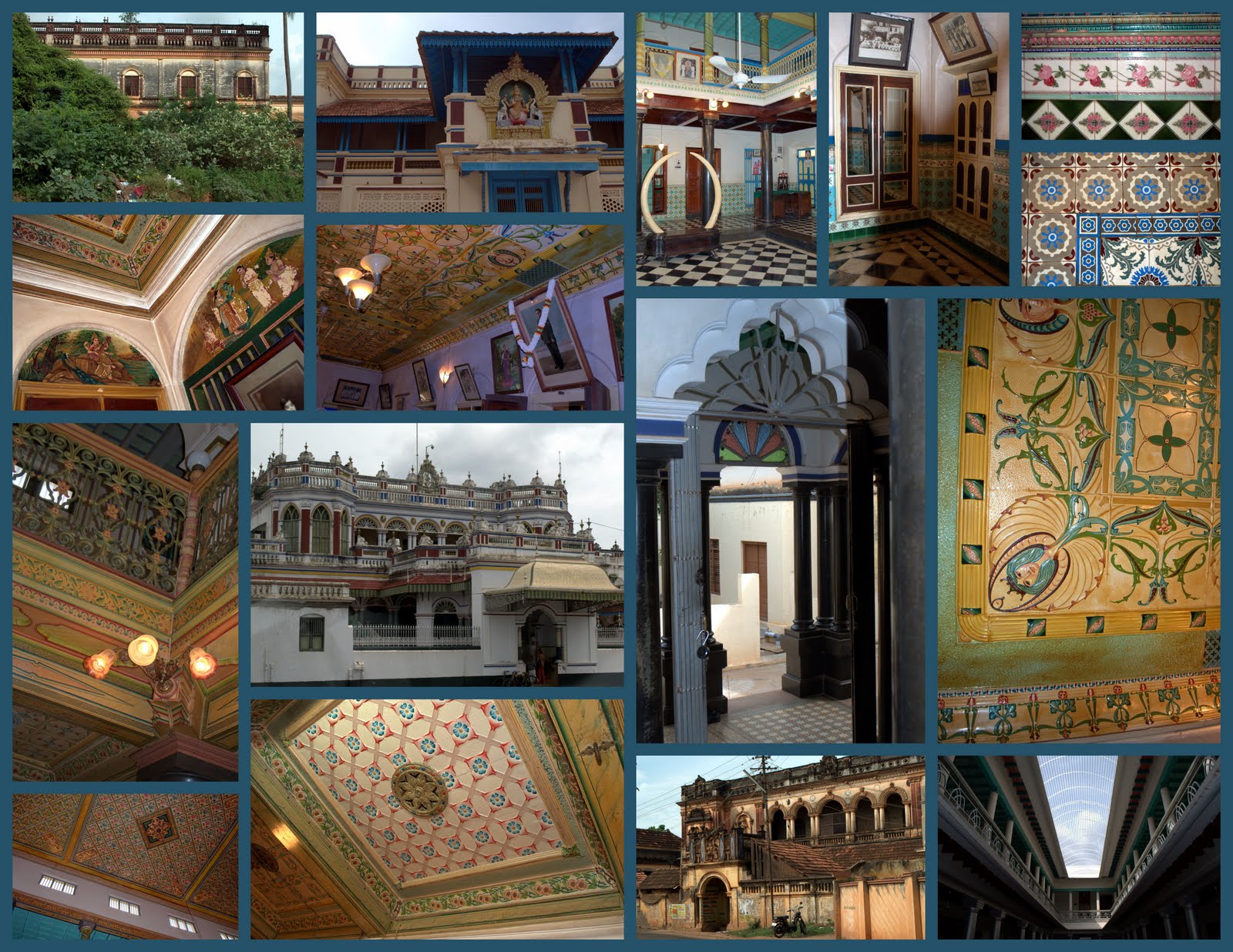
Chettinad is a long bus ride from Madurai but worth the trip to see some of the remnants of a brilliant era in the town's history in the late nineteenth and early twentieth centuries when it was home to a group of wealthy international merchants who built large mansions throughout the township on profits from their trading operations in Asia, Europe and elsewhere.

Today these homes have fallen on hard times but they still retain hints of their former grandeur and seem especially intriguing given their EXTREMELY remote location. Evidently prices in the middle of nowhere on land not considered at all productive is precisely why these mansions are located where they are – these merchants didn't amass their fortunes by being lavish but parsimonious instead!

And they still managed to eat very, very well: our lunch at a local small hotel showed the Chettinad cuisine, famous throughout India, very much worthy of its outstanding reputation.

The bus trip gave us ample opportunity to observe life in rural Tamil Nadu.

We stopped on our way to Chettinad in a small village to visit a batik cooperative giving shelter and training to orphan girls …

… and later at a pre-Hindu temple, the walkway to which is lined with terracotta figures of horses, elephants and cows given by local farmers in thanksgiving for good harvests, a practice dating back thousands of years.

Returning to Madurai we took in a visit to another rural coop, this one making beautiful handcrafted ceramic tiles. Two of our group even got to try making free form tiles themselves, and both turned out quite credible efforts.

It's all these little extras along the way that make Overseas Adventure Travel tours so very special, however long the bus ride might take to bring us to them.

Moving on to Madurai

Late in the afternoon yesterday (Wednesday) we stepped off the bus across from a pillared colonnade which we had learned marked the outer entryway to a Hindu temple complex. Ahead of us down the pedestrian walkway lined with shops, smaller temples and wedding halls we could see the looming gopura, the colorful tower covered with figures of Hindu gods and goddesses that serves as a gate to the Vishnu Hindu temple beyond.

We actually weren't headed to the temple (however fascinating it might have been to visit) but instead to a Veda school just around the corner where young Brahmin boys, ages nine to twenty-six, spent five years learning the Veda, sacred texts passed down through the ages, in preparation for becoming Hindu priests.

We shucked our shoes at the door to a kind of gathering hall where the guys had lockers and would later return to chant for hours at a time. Further down the narrow alley was another hall where the younger boys waited patiently for the session to get underway. We visited both halls and asked questions, both of the priests-in-training and of our guide, prior to listening to several minutes of chanting before returning to our bus.

The whole experience was really quite unworldly. The young men, their long hair pulled back into knots at the back of their heads, wore yellow lungi and horizontal white markings on their faces, arms and bare chests. Yet they were not at all overly serious or solemn but lively, forthcoming and curious about our interest in them, willingly posing for photographs and talking with us freely about themselves, their schooling and their future expectations.

The Vedas they were learning date back several thousand years and must have sounded much the same when chanted by Hundu priests all those centuries ago. Here were the twenty-first century priestly inheritors of a faith tradition thousands of years old, many carrying a family tradition forward into yet another generation – and we were witnesses to that transmission. Wow!

Earlier in the afternoon, after our air flight's arrival in Madurai, we visited Thirumalai Nayaka, a huge palace at the heart of the city. Only about a fifth of its original size, it still made quite an impression. We spent much of our visit looking up at the ornate ceilings and crenelations all around the walls.

Before catching our flight, earlier in the day, we returned to view the Mamallapuram sculptured bas reliefs in better light and another nearby set depicting everyday life in stone carvings from the seventh century.

Enroute to the airport in Chennai, we also barged in on an Indian wedding and ended up having our pictures taken with the bride and groom. The Indians are wonderfully laid back and tolerant of us foreign visitors – and we take advantage of that tolerance every chance we can get!

Tuesday, October 26, 2010

Dravidian Kanchipuram

Our tour bus drove us off two hours or so away today to Kanchipuram, an important center of Dravidian culure, capital of the ancient Pallava kingdom and one of the seven most important Hindu sacred cities in India. Once home to a thousand temples, the modern city still hosts more than fifty, including the two we visited over the course of the morning hours after arriving in town.

Ekambareshvara, built in the sixteenth century, is the largest temple in the city. Here Srini, our guide, walked us through both the temple and various myths, practices and beliefs found within the Hindu fold.

We then bused a short distance away to Kailasanathau, built in the eighth century (roughly at the same time as the Shore Temple we toured yesterday in Mamallapuram), a truly stunning architectural and religious treasure where we examined more sacred stories and a bit more architectural history.

We learned why Brahma (along with Shiva and Vishnu, one of Hinduism's central religious figures) is worshiped only at a single temple in far-off Pushkar; what proked Pavarti, Shiva's consort, to turn into a menacing and dangerous devil; how to differentiate some of the major identifying characteristics associated with each of the most major Hindu deities; why Vishnu and Shiva are always competing; and a host of other interesting bits and pieces.

We now know, too, more about the evolution of Hindu temple architectural styles than we did a day or two ago, learning how the two "models" we saw evidence of yesterday in Mamallapuram came to be incorporated into the design of both temple gates and the temple's main sanctuary and how the once prominent inner sanctuary tower gradually gave away pride of place and size to what came to be called the gopura, the towering gateways guarding access to he now-walled compounds surrounding the sanctum sanctorum at its center.

Had all this taken place in a classroom setting, it likely would have seemed dull and difficult to understand. But being in these two sacred spaces, experiencing it all directly, made all the difference.

We also stopped along the way to and from Kanchipuram to see a snake shrine built around a termite mound in which cobras nest and are worshipped by local women seeking to become pregnant, a silk dying operation and a silk cloth weaving workshop (with a nicely stocked shop right there on the premises - imagine that ...).

Monday, October 25, 2010

Now and Then in Tamil Nadu

After a stroll along the beach walk overlooking the Bay of Bengal early this morning while the air conditioning on our bus was undergoing repair (successfully, thank goodness!), we spent a VERY warm day investigating rural life along the road between Ponticherry and Mamallapuram for much of the morning and then later in the afternoon enjoyed some fascinating hours exploring some seventh century archeological sites of stupendous achievement along the coast here in Mamallapuram itself.

Our first stop gave us the opportunity to observe the opening exercises at a large girls' school with some 900 students ranging from sixth grade through twelfth grade. Next door was a free primary care clinic where local folk could turn for medical emergencies.

Down the road a bit we learned alot about local village guardian deities of Dravidian origin dating back two thousand years or more before the common era! Shrines housing these guardian figures stand at the entrances to rural villages. At night the shrine deity leaps on his trusty steed and circles the village three times to assure all in well. All this has been going on around Tamil Nadu for more than four thousand years!

We then watched some charcoal makers at work and wandered through a local village (where we were engulfed by the kids still too young to go off to school elsewhere). We drove by huge salt flats (a major natural resource gathered locally and sold all across the country) and stopped briefly at a small fresh fish market.

Following lunch at Mamallapuram restaurant (where most of us opted for what we had yesterday, an all-in-one meal called tahli made up of lots of little dishes arranged around the edge of a round tray and eaten with various breads and lots of steamed rice - absolutely delicious!), we checked into the Radisson Resort at Temple Bay, a place so special none of us wanted to leave again ever!

We did have the chance to take an afternoon swim before we took to the road again to visit three major World Heritage Sites dating back to the seventh and eighth centuries. The earliest consisted of the world's largest stone bas relief mural depicting the Hindu creation myth surrounding the origins of the Ganges River; the second, a set of granite "models" used to test out architectural possibilities for temple buildings eventually to be carved out of solid rock on a much larger scale.

Both sites were mightily impressive, for the stone carving skills so obviously in evidence, the beauty of the resulting creations and their very intact survival. Visiting just at sunset made the entire experience all the more magical.

The third site (which we visited first) was the Shore Temple, another impressive example of early Indian temple architecture from the eighth century. Although eroded significantly by sea salt and wind, the tall central tower is still quite dramatic, standing as it does directly on the shore of the Bay (safe behind a seawall reconstructed and reinforced after the 2004 tsunami which surrounded the temple but did not destroy it).

After all this, it was grand to return to our plush hotel to rest, eat dinner and get some much needed rest ...